Imperial/ Colonial

Enslaved and Free Blacks in Saint Domingue
This engraving pairs images of enslaved people and free blacks in four categories: dress, deportment, entertainment, and access to water. Although there are differences between the pairs, these are not as great as they might be.

The Indigo Plant Farm
This print depicts and labels the essential components of a plantation producing indigo, a blue dye used for coloring cloth. Slaves are shown here working at different parts of the production process. In 1789, over 3,000 plantations in Saint Domingue produced indigo.
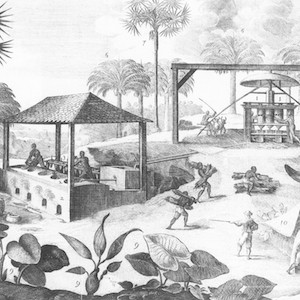
The Sugar Mill
This depiction of a sugar plantation in Saint Domingue emphasizes the grinding mill and refining vats. An overseer with a gun supervises the enslaved labor. By 1789 Saint Domingue excelled at sugar production, outpacing other French colonies and the British alike.

The Barnyard
As shown in this print, numerous activities of plantation life were carried out by enslaved people. This scene includes women and children, who formed a relatively small part of the enslaved population.

Treaties Between the VOC and the Spice Islands
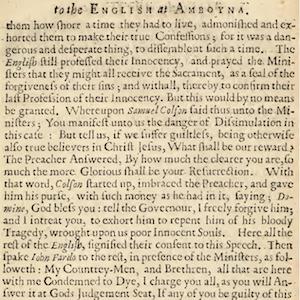
The Amboyna trial was a famous conspiracy case that took place in 1623 when a group of Japanese mercenaries were accused of plotting with English merchants to seize control of a Dutch fort on a remote island in Southeast Asia.
Early Modern Dutch and English Propaganda
The Amboyna trial was a famous conspiracy case that took place in 1623 when a group of Japanese mercenaries were accused of plotting with English merchants to seize control of a Dutch fort on a remote island in Southeast Asia.

Japanese Mercenaries in Early Modern Southeast Asia
The Amboyna trial was a famous conspiracy case that took place in 1623 when a group of Japanese mercenaries were accused of plotting with English merchants to seize control of a Dutch fort on a remote island in Southeast Asia.
Rivalry Between English and Dutch East India Companies
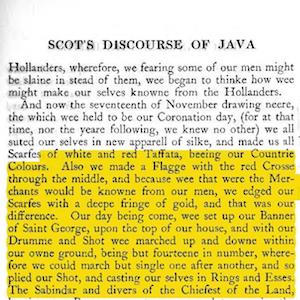
The Amboyna trial was a famous conspiracy case that took place in 1623 when a group of Japanese mercenaries were accused of plotting with English merchants to seize control of a Dutch fort on a remote island in Southeast Asia.

"Torture by Water" in the Early Modern Dutch Empire
The Amboyna trial was a famous conspiracy case that took place in 1623 when a group of Japanese mercenaries were accused of plotting with English merchants to seize control of a Dutch fort on a remote island in Southeast Asia.

Torture in the Early Modern Dutch Empire
The Amboyna trial was a famous conspiracy case that took place in 1623 when a group of Japanese mercenaries were accused of plotting with English merchants to seize control of a Dutch fort on a remote island in Southeast Asia.