North/Central America

Trust Territory Photo Archives
The images in the collection are an extensive record of American views of Micronesian peoples, society, and culture and of the interaction between the United States and the Trust Territories.
United Nations Children’s Fund (UNICEF)
Teachers of modern history and regional or world geography will find a wealth of primary sources on this site that can contribute to filling in a realistic picture of children's situations and the economic, public health, scientific, social, cultural, and political issues that affect them, as
The International Children's Digital Library
The International Children's Digital Library is a feast for children who are bookworms. It is also a treasure trove for teachers of reading, literature, science, social studies, and world cultures or geography. Scholarly researchers will find in its global collection a wealth of material for
Source Collection: Slavery and the Haitian Revolution
Since the revolutionaries explicitly proclaimed liberty as their highest ideal, slavery was bound to come into question during the French Revolution. Even before 1789 critics had attacked the slave trade and slavery in the colonies.

Short Teaching Module: Modern Racism in the U.S. and South Africa
This module has students examine the roots of “modern” racism and make connections between the status of Black individuals in the United States and in South Africa. This approach is designed to foster a discussion on American “exceptionalism,” in particular that U.S.

Short Teaching Module: Gender and Race in Colonial Latin America
When I teach a survey of the colonial history of Latin America, I often focus on the era’s cultural history, and specifically on the issue of hegemony and resistance.

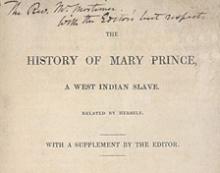
Short Teaching Module: Slavery, Labor, and Gender
In this case study, developed for a lower-division lecture class on “World History 1400-1870,” students explore gender though a primary source the personal account, “The History of Mary Prince, A West Indian Slave Related by Herself.” This first-person account was written by British abolitionists

Journeys in Time, 1809 – 1822: The Diaries of Lachlan and Elizabeth Macquarie
In teaching world history courses, this site would contribute to understanding the nature of British imperial expansion in the Pacific and the business of colonial governance.
"I Didn't Raise My Boy to Be a Soldier" [Song]
By 1915, Americans began debating the need for military and economic preparations for war. Strong opposition to "preparedness" came from isolationists, socialists, pacifists, many Protestant ministers, German Americans, and Irish Americans (who were hostile to Britain).