Japanese Immigrants, Internment Camps, and American Loyalty



Overview
This source collection focuses on the interviews and stories of first and second-generation Japanese Americans internment during World War II.
Essay
After the bombing of Pearl Harbor on December 7, 1941, President Franklin D. Roosevelt issued Executive Order 9066 which required the detainment of Japanese Americans throughout the West Coast. Issei (first-generation), Nisei (second-generation; with US citizenship), and Sansei (third-generation; born of ‘Nisei’ Japanese Americans with US citizenship) were detained throughout the West Coast and southwestern US in the Wartime Civil Control Administration’s “Assembly Centers”, the War Relocation Authority’s “Relocation Centers”, and the Department of Justice’s “Internment Camps”. Using this source collection, which includes oral history interviews with Japanese Americans incarcerated during this period, students will be able to identify the key elements of interviewing as a means of historical interpretation and how memory is an important addition to teaching history. These sources will also provide students with a general understanding of how Japanese immigrants and their descendants were treated in the United States during WWII. Over half of the roughly 120,000 detainees were children.
Students can explore this aspect of incarceration by examining Sugimoto’s painting of girls playing in the snow included in this source collection.
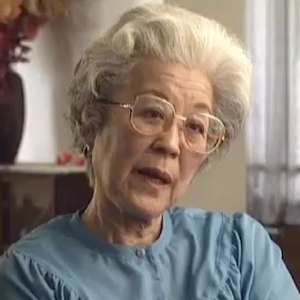
The interviews, one of Kenge Kobayashi and the other of Aiko Herzig-Yoshinaga, both Niseis, detail their stories in their respective camps. Kobayashi’s experience tells of the trouble he and his family faced when they were presented with what is informally known as the loyalty questionnaire. This form, issued by the WRA to Nisei adult men in WRA concentration camps and Japanese Americans already serving in the military, asked if they would swear their allegiance to the United States, renounce any allegiance to the Emperor of Japan, and if they would be willing to be drafted into the military. This questionnaire was widely criticized by the detained Nisei Japanese Americans who felt they were being accused of being disloyal to a country they have sole citizenship in. Kobayashi’s answers mirror that reality as he details fights within his camp. Herzig-Yoshinaga’s story enlightens the reality of women living in the camp. Her story also discusses the trouble pregnant women faced, as she was nine-months pregnant at the time of her detainment.
Interpreting these interviews for the classroom can be beneficial for students as they grow their communication and critical thinking skills. How can studying an interviewer's wording of a question shape an interviewee’s answer? Where should interviewers place certain questions within their script to receive a receptive response? As shown in Herzig-Yoshinaga’s interview (part two), when is it appropriate for an interviewer to step in and ask an unprompted question?
Primary Sources
Japanese American Incarceration, Interview
Annotation
Japanese American Incarceration at Manzanar, California, Interview
Annotation
Japanese American Incarceration at Manzanar, California, Interview Part 2
Annotation
Girls Making Snowman
Annotation
Credits
Michael Caraballo is an intern for the Roy Rosenzweig Center for History and New Media.